Course Overview
An intensive exploration of deep learning applications in medical imaging. The coursework involved implementing and optimizing advanced neural network architectures for dynamic MRI reconstruction and cardiac image segmentation, balancing computational efficiency with high-fidelity clinical outputs.
Core Project 1: Dynamic MRI Reconstruction
Engineered a deep learning pipeline for reconstructing dynamic cardiac cine MRI from 5x undersampled k-space data, addressing the trade-off between spatial-temporal resolution and acquisition time.
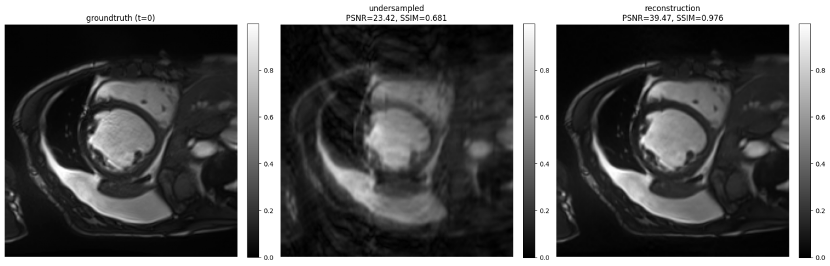
- Architecture Design: Evaluated multiple architectures (3D ResNet, U-Net+GRU, 2D+1D U-Net) and finalized a 3D U-Net integrated with CBAM (Convolutional Block Attention Module). This design leveraged 3D convolutions for temporal feature extraction and CBAM for global spatial-channel attention, balancing high reconstruction quality with GPU memory constraints.
- Cascaded Networks & Data Consistency: Implemented a 3-stage cascaded architecture incorporating Data Consistency (DC) layers. This design utilized k-space prior information to enforce physical constraints during reconstruction, significantly boosting performance to an average PSNR of 37.07 dB and SSIM of 0.9626.
- Optimization Strategy: Conducted ablation studies on loss functions, determining that L1 Loss slightly outperformed L2 Loss for this specific reconstruction task. Carefully managed dropout rates, discovering that excessive dropout degraded the U-Net’s residual connections and hindered convergence.
Core Project 2: Deep Learning Cardiac Cine MRI Segmentation
Developed and rigorously evaluated multiple 2D segmentation models (U-Net variants, MedNeXt, MMNet) to accurately delineate the right ventricle, myocardium, and left ventricle.
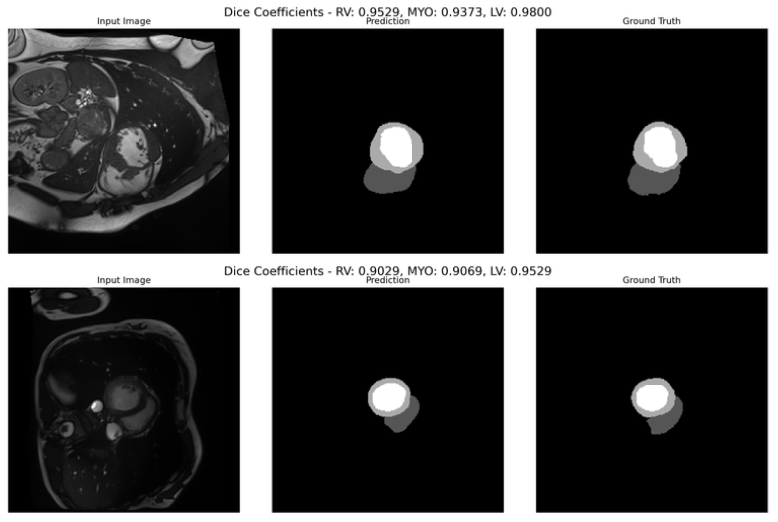
- Model Implementation & Data Augmentation: Built a baseline 2D U-Net with skip connections and optimized its performance using extensive data augmentations (random affine transformations, vertical/horizontal flips) to mitigate overfitting, achieving a Mean Dice score of 0.9350. Successfully reproduced MMNet, utilizing dilated convolutions to capture multi-scale features without extensive preprocessing, achieving a 0.9611 Dice score on the left ventricle.
- Mathematical Loss Optimization: Conducted a rigorous first-principles analysis of objective functions. Identified that Cross-Entropy loss suffers from severe directional bias due to background class dominance (>95%), while Dice Loss provides robustness to class imbalance by optimizing the intersection-to-union ratio.
- Gradient Stability & Combined Loss: Analyzed the gradient formulation of Dice Loss, identifying numerical instability and gradient vanishing problems when predictions are near random initialization. Applied a combined loss formulation with dynamically adjusted weights to leverage the early-stage gradient stability of Cross-Entropy and the late-stage boundary precision of Dice Loss.
Technical Stack
- Languages: Python
- Concepts: K-Space Signal Processing, Spatial-Temporal Attention (CBAM), Data Consistency, Loss Function Gradient Analysis, Dilated Convolutions, 3D U-Net, MedNeXt, MMNet, ResNet.
- Tools: PyTorch, NumPy, MatPlotLib.