Research

4D Holographic Particle Tracking Velocimetry (PTV) (Feb 2026 - Present) Undergraduate Researcher | Computational Imaging Lab, UC Berkeley Advised by Dr. Nalini Singh & Mingxuan Cai Details Lagrangian Representation: Departed from traditional grid-based views by adopting a Lagrangian perspective, using precise floating-point coordinates to represent individual particles for off-grid trajectory tracking. Forward Modeling: Developed an analytical forward projection model to optimize optical kernels, improving the fidelity of in-line holographic reconstructions. Hybrid Initialization: Implemented an Angular Spectrum Method (ASM) combined with Gaussian representations for robust particle localization. Physics-Informed Neural Field: Represented complex velocity fields using Multi-Layer Perceptrons (MLPs) to regularize ill-posed inverse problems in fluid dynamics. Pipeline Engineering: Built an end-to-end pipeline integrating particle localization and 4D flow field reconstruction. Zero-Day Vulnerability Detection via Revelio (Mar 2026 - Present) Research Assistant | Sky Computing Lab, UC Berkeley Advised by Yiwei Hou ...
April 20, 2026

CS168: Introduction to the Internet: Architecture and Protocols

Course Overview An intensive exploration of computer networking fundamentals, internet architecture, and protocol design. The coursework focused on building core network utilities and foundational protocols from the ground up, moving from the network layer (routing and packet parsing) up to the transport layer (reliable data transfer and flow control). Core Project 1: Robust Network Diagnostic Tool (Traceroute) Engineered a resilient traceroute client capable of handling real-world internet volatility and anomalous router behaviors. ...

April 20, 2026

CS188: Introduction to Atifitial Intelligence

Course Overview An intensive, project-driven exploration of foundational Artificial Intelligence algorithms. The coursework utilized the classic Pacman environment to bridge theoretical AI concepts with practical implementations, covering autonomous planning, decision-making under uncertainty, probabilistic tracking, and modern deep learning architectures. Core Project 1: State-Space Search & Adversarial Planning Engineered autonomous agents capable of navigating complex deterministic mazes and surviving stochastic, adversarial environments. Heuristic Search Strategies: Implemented uninformed search (DFS, BFS, UCS) and informed search (A* Search). Designed highly optimized, custom admissible and consistent heuristics to solve complex state-space problems, such as finding the optimal path to consume all food dots and navigating through specific corner coordinates. Adversarial Game Tree Search: Modeled adversarial ghost behaviors by developing multi-agent search algorithms. Implemented Minimax with Alpha-Beta Pruning to drastically reduce the expanded search space, and Expectimax to account for the stochastic, sub-optimal nature of random ghost movements. Designed custom evaluation functions to dynamically weigh game states. Core Project 2: Reinforcement Learning & MDPs Modeled the Pacman environment as a Markov Decision Process (MDP) to develop agents that learn optimal policies through trial and error. ...

September 1, 2025
MRI Reconstruction

BME1312: Artificial Intelligence in Medical Imaging

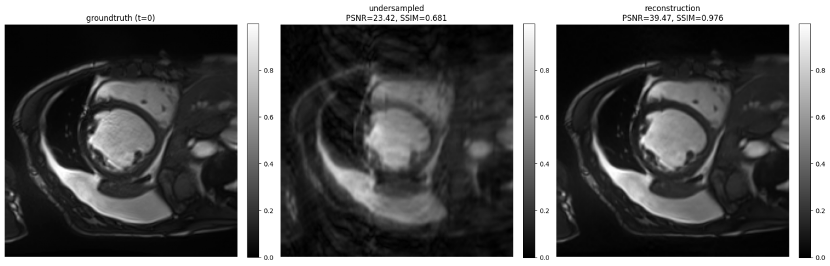
Course Overview An intensive exploration of deep learning applications in medical imaging. The coursework involved implementing and optimizing advanced neural network architectures for dynamic MRI reconstruction and cardiac image segmentation, balancing computational efficiency with high-fidelity clinical outputs. Core Project 1: Dynamic MRI Reconstruction Engineered a deep learning pipeline for reconstructing dynamic cardiac cine MRI from 5x undersampled k-space data, addressing the trade-off between spatial-temporal resolution and acquisition time. ...

February 1, 2025

SI100B: Introduction to Information Science and Technology

Course Overview A practical exploration of Object-Oriented Programming (OOP) and software design principles through the end-to-end development of a fully functional 2D Roguelike game. The project utilized Python to build custom game mechanics, focusing on event-driven state management, rendering pipelines, and collision physics. Core Project: Python-Based Roguelike RPG Co-developed an expansive, tile-based 2D RPG featuring dynamic map environments, scalable enemy logic, and encapsulated rendering systems. 1. Game Engine & Rendering Subsystems Architected a centralized GameManager infrastructure to orchestrate global event loops, entity updates, and frame-by-frame rendering. ...

September 1, 2023